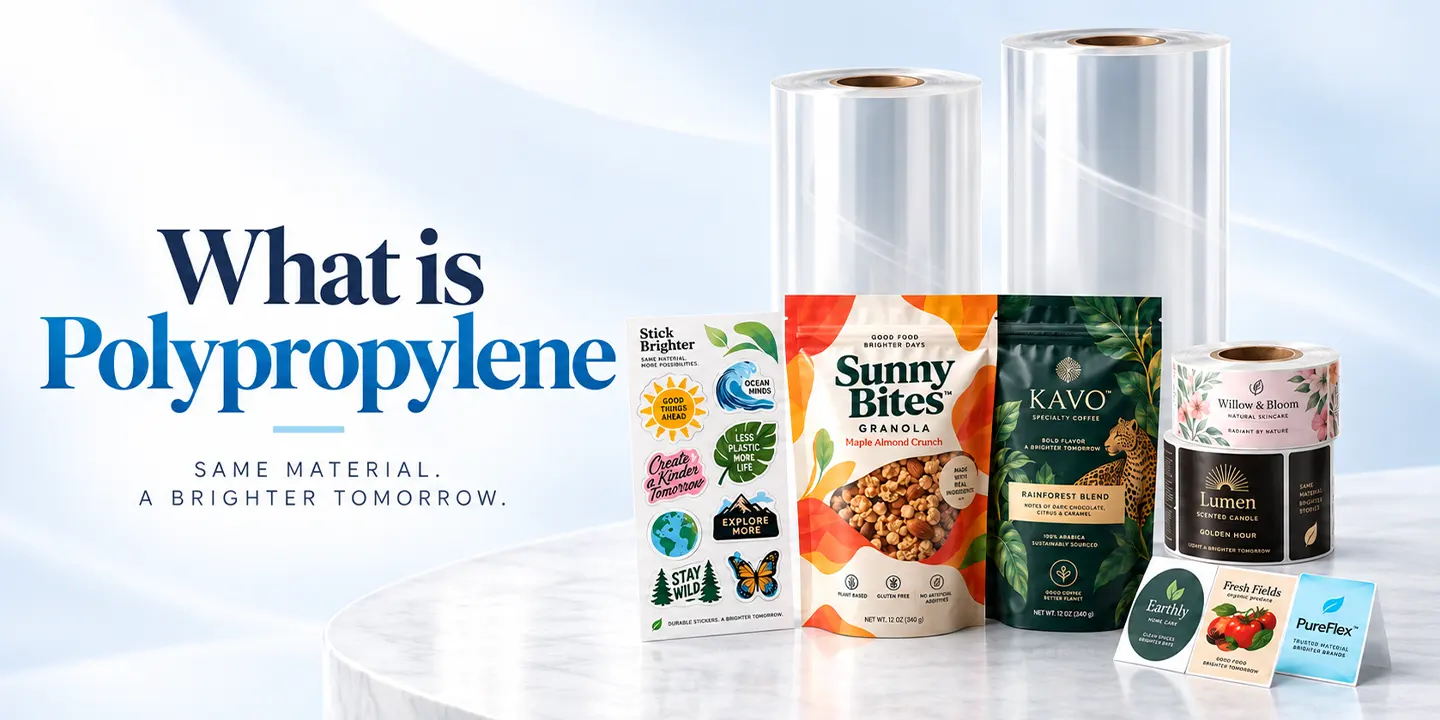
What is Polypropylene? Uses & Importance | Ultimate Guide
 Autumn Phillips
 4 min read
 Sep 21, 2026
The most commonly used plastic in the packaging industry is polypropylene. Maybe you know it by its short name, which is PP, or by recycling code #5. Whether you need it for food containers, bottle caps, labels, or packaging, PP is convertible into any shape. One material can have several properties.
In packaging, market consumption exceeds 16 million tons annually and is expected to grow at a CAGR of 6.22% between 2026 and 2035. But the main thing is, what is PP exactly, and why is it so popular in the packaging industry?
This detailed guide by LabelPouches will cover everything that you need to know. From its chemical properties to temperature tolerance, advantages, disadvantages, and all other related things.
What is polypropylene? Chemical & Physical Fundamentals
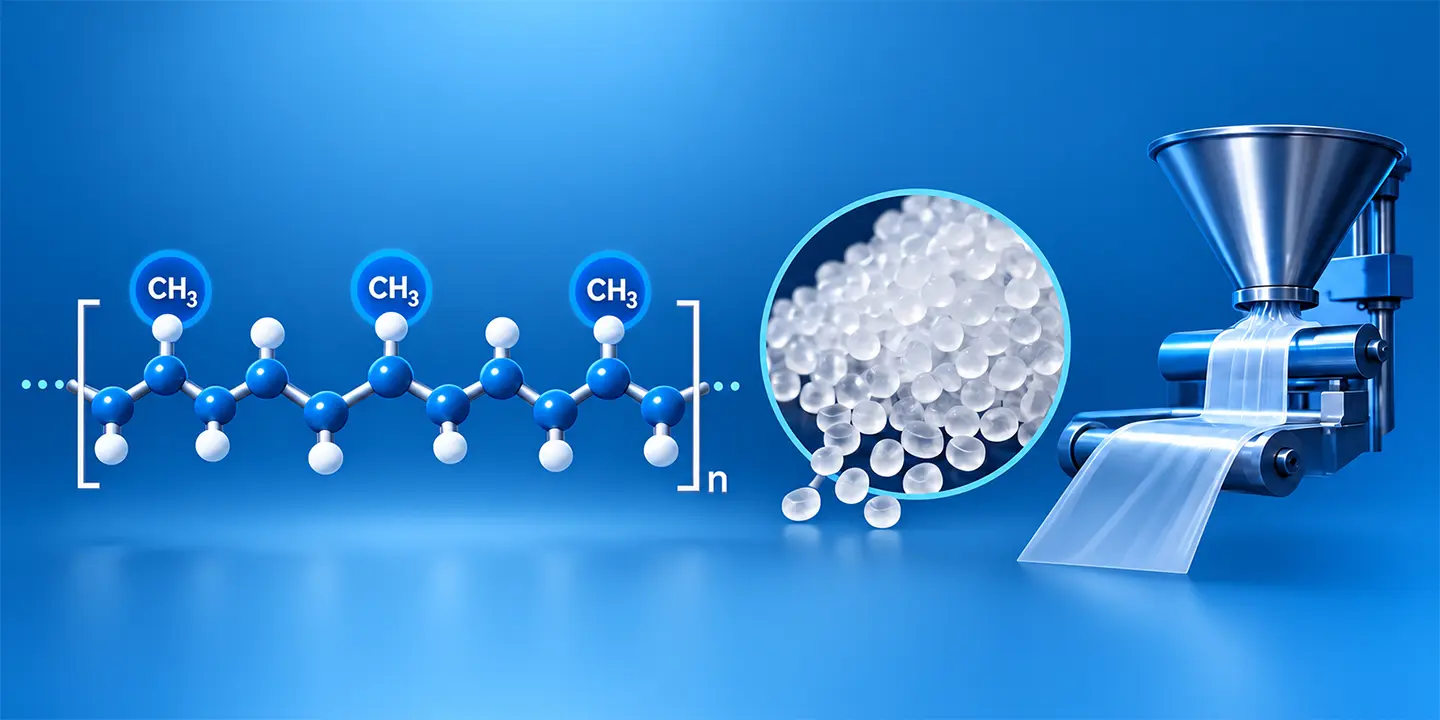
Polypropylene is a thermoplastic polymer, and its chemical formula is (C₃H₆)ₙ. PP is similar to polyethylene but has a different methyl group (CH₃). It is attached to every other carbon atom in its molecular backbone. The stiffness and thermal resistance of PP are increased by this group.
In the packaging industry, thermoplastics play an important role. It is heated until it melts and softens, and then it is reshaped into something else. Other materials can have only one form, but PP is available in rigid or flexible form. A product made with PP or any other material will look different, but they are from the same polymer family.
Key Properties of Polypropylene for Packaging
| Property | Typical PP Characteristic | Why It Matters in Packaging |
|---|---|---|
| Density | 0.895–0.930 g/cm³ | PP has one of the lowest densities among common commodity packaging plastics, helping create lightweight packaging. |
| Melting Point | 160°C–171°C (320°F–340°F) | Supports packaging applications that require better heat resistance during filling, processing, or use. |
| Heat Deflection Temperature (HDT) | Up to 100°C–120°C (212°F–248°F) | Helps PP packaging maintain its shape under elevated temperatures and heat exposure. |
| Moisture Resistance | Excellent moisture barrier; MVTR can be around 0.5 g-mil/100 in²/24 hr | Helps reduce moisture transfer and protect products that need a dry packaging environment. |
| Young's Modulus | 1,300–1,800 N/mm² | Gives PP a useful level of stiffness for containers, trays, caps, and other packaging formats. |
| Glass Transition Temperature | Around 0°C (32°F) | Below this temperature, untreated PP can become more brittle, which is important for cold-storage applications. |
| Recycling Code | #5 | Identifies the packaging material as polypropylene for material sorting and recycling systems. |
| Chemical Resistance | Good resistance to many acids, bases, oils, and fats | Makes PP suitable for food, personal care, household, and chemical product packaging. |
| Fatigue Resistance | High | Supports repeated bending and flexing, making PP useful for caps, closures, and living-hinge designs. |
| Processing Versatility | Molded, extruded, and converted into films | Allows PP to be used for containers, trays, films, labels, caps, and other packaging formats. |
How Is Polypropylene Made?
In the 1950s, during research on polymer chemistry, chemists started developing PP. Paul Hogan and Robert Banks produced an early form of polypropylene while experimenting with propylene gas.
It was first made in 1954 by Italian chemist Giulio Natta. He created a catalyst that produced a form of polypropylene with special properties. Polypropylene is used by various industries due to its strength, stiffness, heat resistance, and low cost.
Propylene is also known as propene. It is obtained during fossil fuel refining and petrochemical processing. A polymer chain is created by attaching small propylene molecules together; this is known as polymerization.
As a result, resin pellets are produced, which become the starting point of packaging manufacturing. Due to its stiffness, strength, and low-cost qualities, PP is used in many industries. Manufacturers melt and process the resin into different things, which include:
-
Pouches
-
Caps and closures
-
Thermoformed trays and cups
-
Flexible films
-
Woven bags and sacks
-
Labels and wraps
-
Laminated packaging layers
Why Is Polypropylene Important in the Packaging Industry?
This material-based packaging holds the product as well as protects it from moisture and different temperature conditions during shipping. It is one of the lightweight and useful materials that also provides stiffness and flexibility. Different brands use PP material packaging for their flexible packaging solutions. It handles heat so well, unlike other standard low-heat plastics and rigid boxes.
From mylar bags to pouches and labels to stickers, you can package food, cosmetics, chemicals, and retail items. And enhance branding and marketing with labels and stickers.
Temperature Tolerance & Thermal Performance in Packaging
Due to its temperature-resistant quality, PP is widely used by the food packaging industry. Each type of polypropylene has a different temperature tolerance.
Hot-Fill, Retort & Microwave Safe
-
Hot-Fill Capability: PP can tolerate temperatures from 85°C to 100°C (185°F-212°F) without losing its structure.
-
Microwave Compatibility: PP has an operating ceiling of 120°C-135°C and is the best option for microwaveable meal trays.
-
Autoclave & Retort Sterilization: PP resists because of the use of retort sterilization protocols in medical packaging and shelf-stable food products.
Cold-Temperature Limitations and Methods
PP homopolymer can become fragile near its glass transition temperature (0 °C). The packaging overcomes this limitation and is flexible in sub-zero freezer environments (-20°C).
How Is Polypropylene Processed for Packaging?
It’s flexible, so manufacturers can turn it into containers, flexible films, caps, pouches, trays, labels, and other packaging-related products.
For the final packaging, the process method depends on the desired flexibility, thickness, and performance.
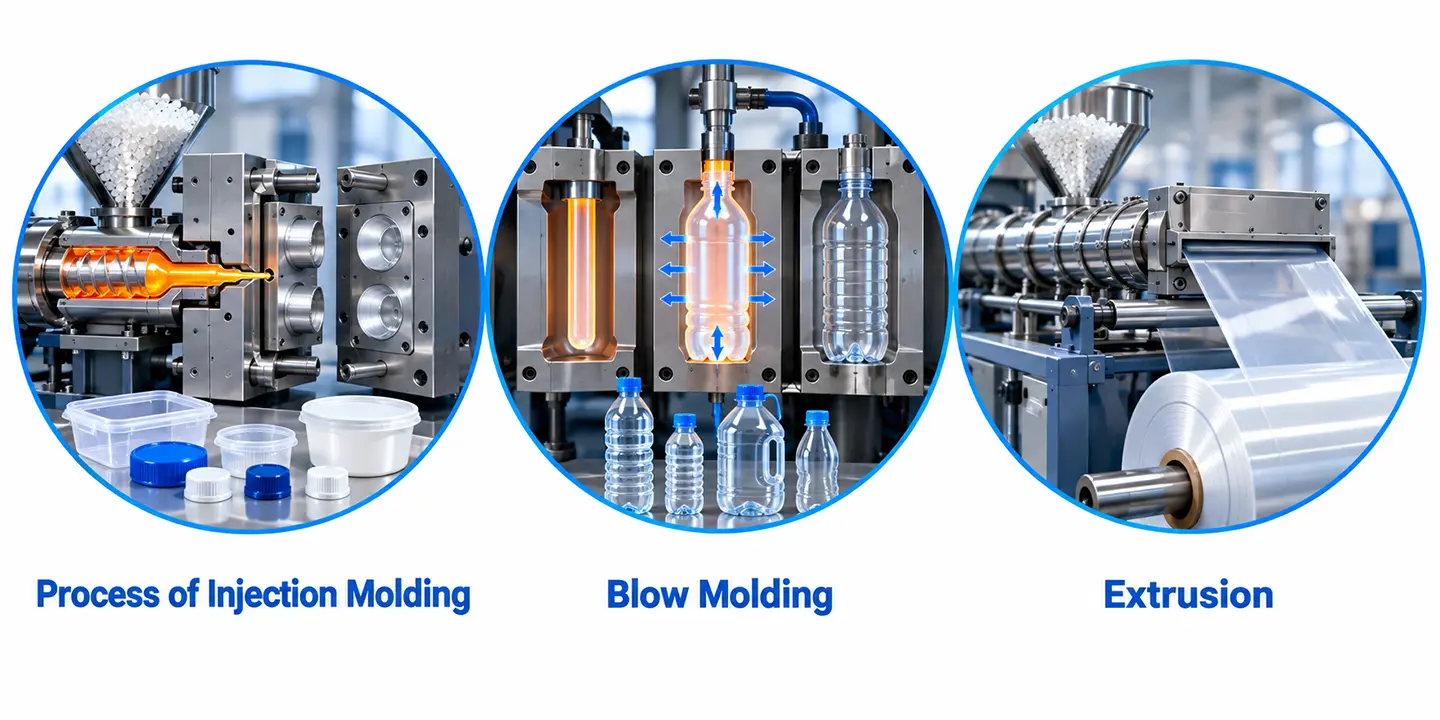
Process of Injection Molding
Manufacturers use this method to make different types of packaging units. The molten resin is injected into a special mold. After the material gets cool they open, they open the mold to take out the final product.
This process gives accurate shape and size. You can make bottle caps, closures, food containers, tubs, lids, and other packaging products like this. Manufacturers who need consistent shapes and dimensions use this method.
Blow Molding
This method is used to create hollow PP packaging. A tube-like shape, which is known as a preform, is heated and formed from PP. Then air enters it, which forces the plastic to take the shape of the inside walls of the molds.
It takes the mold's shape after cooling. This process makes hollow bottles, boxes, and containers where a lightweight structure is necessary.
Extrusion
In this method, a solid resin polymer melts and is then forced through a shaped die. After it cools down, they cut it into the required length. It is mostly used to make products like sheets, tubes, pipes, and films. For further flexible packaging, films are coated with special finishing and printing to achieve the required barrier and sealing properties.
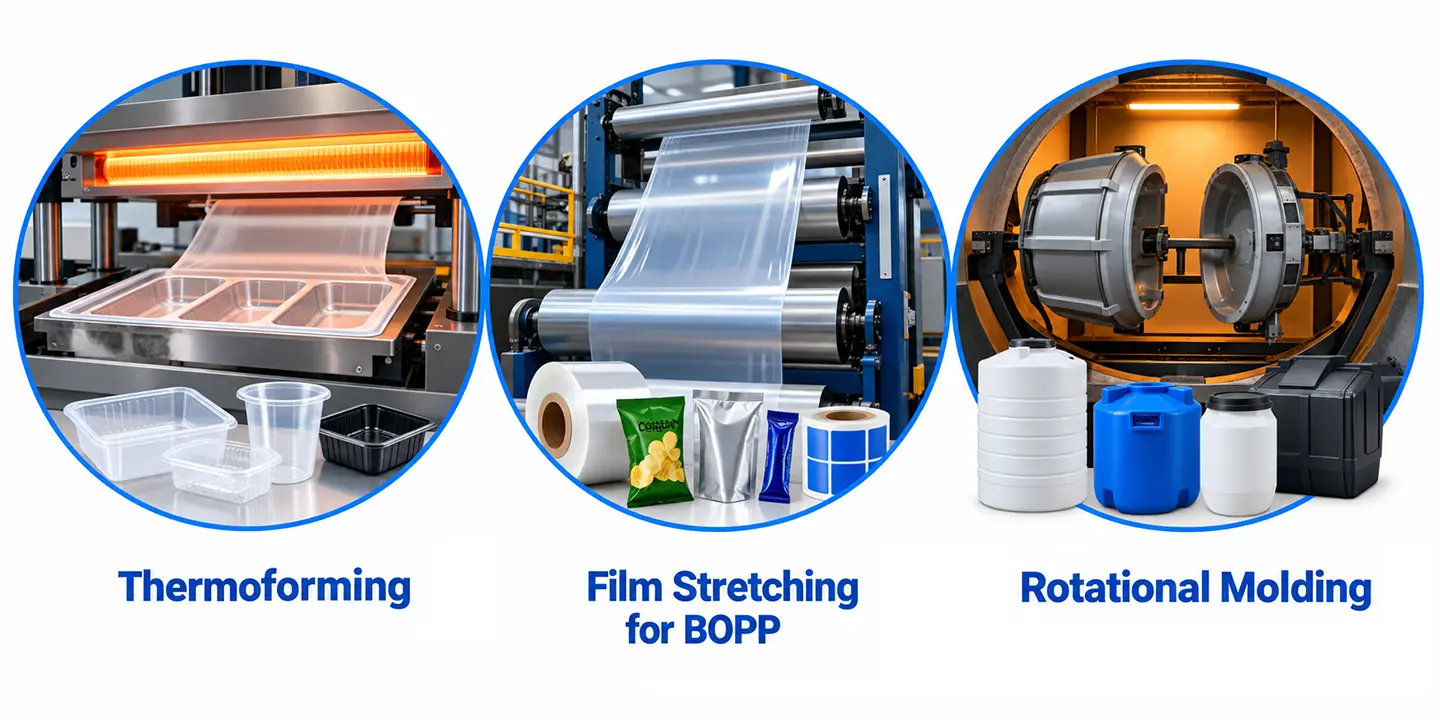
Thermoforming
In thermoforming, a PP sheet is heated until it becomes soft, and then it is formed over a mold to give it a certain shape. It is mostly ideal for food trays, cups, and other shallow packaging. It allows manufacturers to create lightweight packaging products.
Film Stretching for BOPP
Film stretching is important for flexible packaging. When PP film stretches in two different directions, it creates biaxially oriented polypropylene (BOPP). This stretching process improves many properties compared with an unstretched PP film.
They are commonly used in food packaging, labels, wraps, pouches, and laminated packaging.
Rotational Molding
This process uses a mold that contains polymer material that is heated while the mold rotates. The material spreads across the mold and forms a required hollow shape. It is less common than other processes. It is mostly used for large hollow products.
Polypropylene vs. LDPE and HDPE in Packaging
We should compare it with other polyolefins to understand where polypropylene fits. Given below table will help you better understand:
| Property / Feature | Polypropylene (PP) | High-Density Polyethylene (HDPE) | Low-Density Polyethylene (LDPE) |
|---|---|---|---|
| Resin Code | #5 | #2 | #4 |
| Density (g/cm³) | 0.895 – 0.915 | 0.940 – 0.965 | 0.910 – 0.925 |
| Melting Point | 160°C – 171°C | 125°C – 135°C | 105°C – 115°C |
| Clarity / Transparency | Translucent to Clear (Co-poly or BOPP) | Opaque to Hazy | Translucent to Clear |
| Rigidity & Hardness | High | Medium-High | Low (Flexible) |
| Moisture Barrier | Excellent | Superior | Good |
| Flex Crack Resistance | Excellent (Living Hinges) | Good | Outstanding |
| Primary Form Factor | Containers, Closures, Trays, Films, Clear Labels | Milk Jugs, Bottles, Drums | Squeeze Bottles, Shrink Film, Flexible Pouches |
BOPP and Regular PP: What Is the Difference?
BOPP stands for biaxially oriented polypropylene and is a type of polypropylene. It is used for flexible packaging because of its stretched structure. Manufacturers use BOPP when they need below things:
-
Transparent appearance and good visual quality
-
Good stiffness
-
High tensile strength
-
Easy to print
-
Resistance to moisture
-
Lightweight material
All BOPP is made from polypropylene, but that does not mean all PP is BOPP. In order to give good print quality and appearance, it is combined with outer layers.
Types of Polypropylene in Packaging
The packaging industry does not rely on a single grade of PP. Everything depends on the needs. Different PP grades are there for separate packaging needs.
PP Homopolymer
It contains propylene monomers. It is heat-resistant with superior thermal resistance (melting point around 165°C–171°C). It helps to block moisture and withstand chemical degradation very well. It is commonly used for durable food, medical, and consumer packaging.
PP Random Copolymer
A thermoplastic that is formed due to the addition of a small amount of ethylene comonomers (from 1% to 7%) into the polymer chain. In comparison with other PP, it possesses more flexibility. It provides high optical clarity and gloss; it interrupts the crystallinity of the polymer. Used in the production of transparent packaging, films, and medical packaging.
PP Impact (Block) Copolymer
This is PP, which is formed due to the addition of ethylene blocks. It has a relatively high share of ethylene-propylene rubber phases (from 4% to 15%). It provides impact resistance and non-shattering at low temperatures down to -20°C. Used in the production of frozen food packaging, thin-walled packaging, and tote boxes, etc.
Key Packaging Applications of Polypropylene
Its flexibility makes it useful for many industries around the world. Its light weight, moisture resistance, and chemical resistance make it suitable for products that need to be handled with care. LabelPouches is a trusted packaging company, which is why many industries depend on it. They are free to choose whatever they want, according to their preferences.
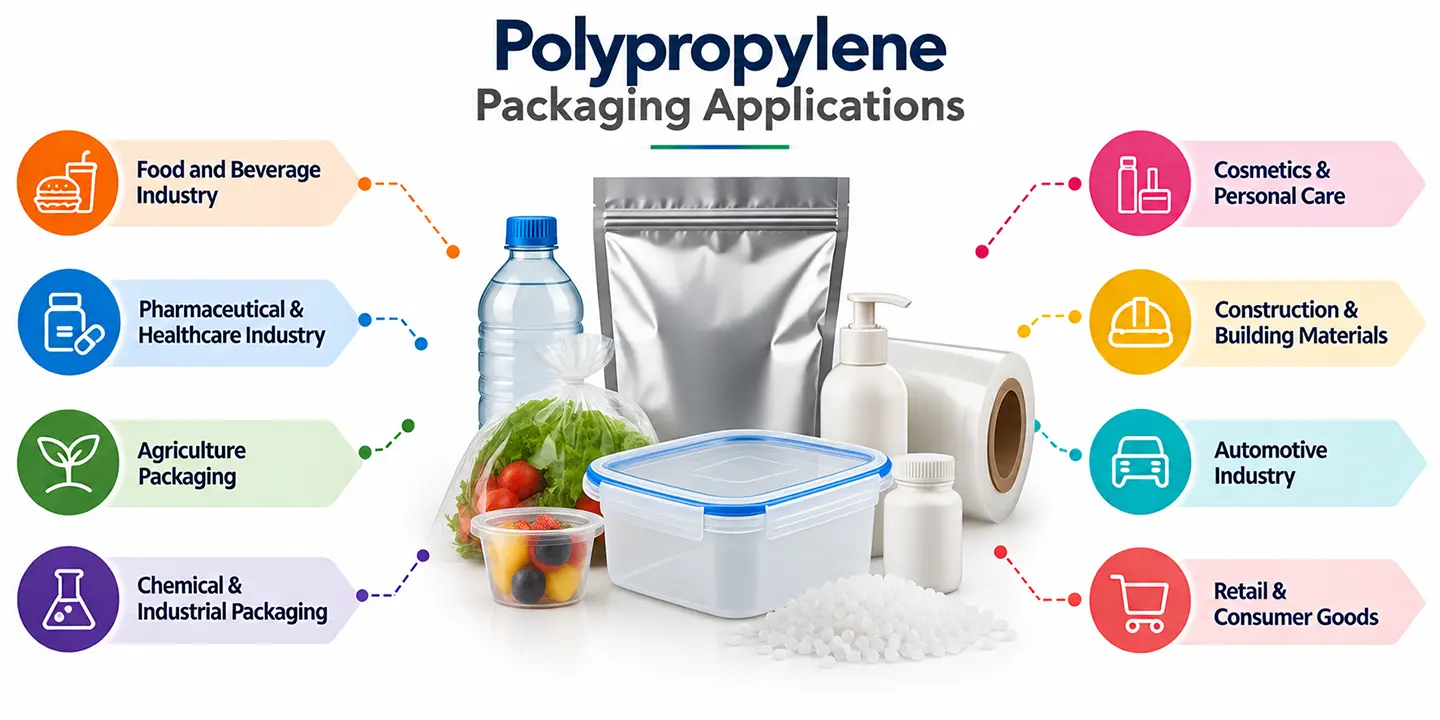
Food and Beverage Industry
Food and beverage companies are the biggest users of polypropylene. PP is used by these industries to make trays, lids, takeaway containers, sachets, bottle caps, and flexible packaging.
It is suitable for single-serving packaging of sauces, condiments, snacks, and other food products. BOPP films are flexible and have good printability, so it is a good choice for this industry.
Pharmaceutical & Healthcare Industry
It is chemical resistant and can tolerate sterilization processes; that’s why it is a perfect fit for the medical and pharmaceutical industry. To provide durable and hygienic packaging for products, this option can be used. Common applications are medicine containers, pill packaging components, and laboratory containers.
Agriculture Packaging
PP is an ideal option for packaging and transportation in the industry of agriculture. For grains, seeds, and other related products, woven PP sacks, FIBC bags, and BOPP bags are used. Because they give strong structure, even though they are lightweign but can handle weight.
Chemical & Industrial Packaging
Polypropylene’s chemical resistance and strength make it a reliable choice for the chemical industry. Because they require packaging that can handle different storage conditions. It can be used in chemical bags, industrial containers, warning sign stickers, and liners, etc. In industries where strength is an important factor, it can be used.
Cosmetics & Personal Care
PP is used in the cosmetic industry. It resists oil and many other chemical formulations; that's why it is ideal for products like creams, lotions, and hair products. Due to the lightweight nature of PP, brands can make low-weight packaging without affecting the quality.
Construction & Building Materials
For the packaging of cement, aggregates, and powders, PP material can be used. Its strength helps packaging withstand different conditions. It can be produced in different shapes and sizes to make it suitable for handling.
Automotive Industry
PP is not only used in the packaging industry. Its properties make it ideal for automotive manufacturing. It can be used for car labels, battery cases, interior panels, dashboards, and bumpers. Its low weight does not affect the overall vehicle weight.
Retail & Consumer Goods
Polypropylene is found in the packaging of everyday products. Storage boxes, food boxes, and reusable bags can be manufactured with PP. It helps manufacturers create disposable packaging.
Why Do So Many Industries Choose PP Packaging?
Almost all industries use this material because it fulfils different packaging needs. You can make pouches and woven sacks with it as well. The following are the benefits of this material for packaging manufacturers:
-
It is lightweight
-
Provides heat resistance
-
You get moisture resistance
-
It keeps the packaging chemical-resistant
-
The processing flexibility is high
-
You get high design versatility
-
It also offers higher recyclability
Recycling & Circularity of Resin Identification Code #5
This code was first introduced by SPI (Society of Plastics Industry). You can recycle the PP resin by using code #5. Many companies use this code in North America and Europe, and it is supported by 65% of people.
Lightweight Advantage
The polymer becomes less dense than PET (1.33 g/cm³) and PS (1.04 g/cm³) because of the lightweigghtedness. It offers 12% to 30% less in terms of raw material use for the container that has the same capacity.
Mechanical & Chemical Recycling
Post-consumer waste can be converted back into chemical feedstock through the recycling process. It can be isolated from other materials with advanced near-infrared by material recovery facilities.
Advantages and Disadvantages of Polypropylene in Packaging
There are always pros and cons to everything. Before specifying PP for packaging, everybody should know about its advantages and disadvantages.
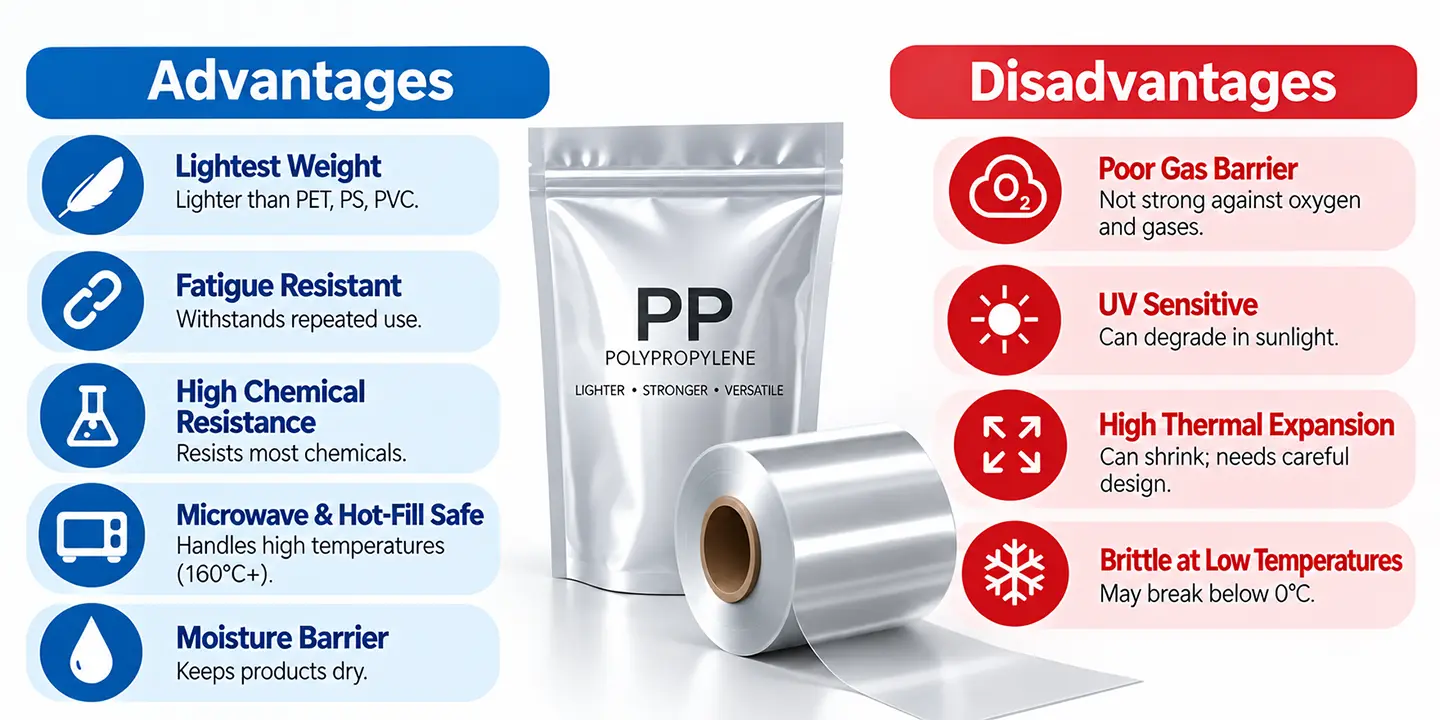
Advantages
-
Lightest Weight Material: PP is lighter than PET, PS, or PVC with a density of 0.90g/cm3. This means manufacturers can make more pieces with the same amount of resin.
-
Exceptional Fatigue Resistance: It can tolerate different handling conditions without breaking or cracking. It is suitable for bottle caps, hinged lids, etc., which are opened and closed many times.
-
High Chemical Resistance: PP is highly chemical resistant, and most of the solvents, bases, and non-oxidizing acids do not leave any effect on it.
-
Microwave & Hot-Fill Safe: It allows safe thermal processing and consumer reheating due to its high melting point (160°C+).
-
Innate Moisture Barrier: Due to its low MVTR, it preserves products from moisture and prevents dry goods from absorbing humidity.
Disadvantages
-
Poor Gas/Oxygen Barrier: PP can be combined with EVOH or other barrier coatings to provide protection because, alone, it is not strong enough to protect against oxygen and other gases.
-
Susceptibility to UV Degradation: PP can weaken if it remains in contact with sunlight for a long time period. UV stabilizers such as HALS may be added to improve its outdoor resistance.
-
High Thermal Expansion: During injection molding, careful molding design is needed to maintain the correct shape and size because PP can shrink when it remains in a cold environment for a long time.
-
Low-Temperature Brittleness: Standard PP can break below the temperature 0°C. To increase its performance in cold conditions, modified PP grades can be used.
Future Trends: Sustainable Innovations in PP Packaging
The improvement in technology makes PP packaging more functional for reuse. This advancement also provides support for better recycling processes. Mentioned next are some of the aspects in which you will see improvement in the near future:
Ultra-High Barrier Monomaterial Structures
Traditional packaging includes PP and PET. PE is also included in this because all three of them provide a high level of barrier. But new monomaterials are now available in the market that offer more protection from oxygen.
Manufacturers can use EVOH and ALOx barrier coatings to improve the protective performance. These coatings protect sensitive items from oxygen and moisture while supporting Code #5 recyclability.
Post-Consumer Recyclate (PCR-PP) Integration
This issue becomes important since brands now try to find new ways to decrease the usage of plastic. The quality of the material is improved with higher washing and sorting quality. Deodorization has also been enhanced with this.
Advanced Nucleating Agents
Such agents ensure a quick crystallization of PP during processing. These additives can improve the appearance and transparency of PP packaging.
Final Thoughts: Choosing Polypropylene for Modern Packaging
PP is identified by recycling code #5. The material is popular for use in packaging all around the world just because of the material’s toughness, rigidity, and durability. This packaging material is used by nearly all industries for packaging purposes.
Some considerations must be taken into account while selecting PP for packaging materials. They include operating temperature range, moisture and oxygen barrier needs, and recyclability. Proper material selection will allow you to create packaging materials that will be able to add value to your branding efforts and will help your brand make an impact on this market.
Brands looking to get durable packaging can contact LabelPouches for a quotation. Our team of experts is available 24 hours per day to help you out