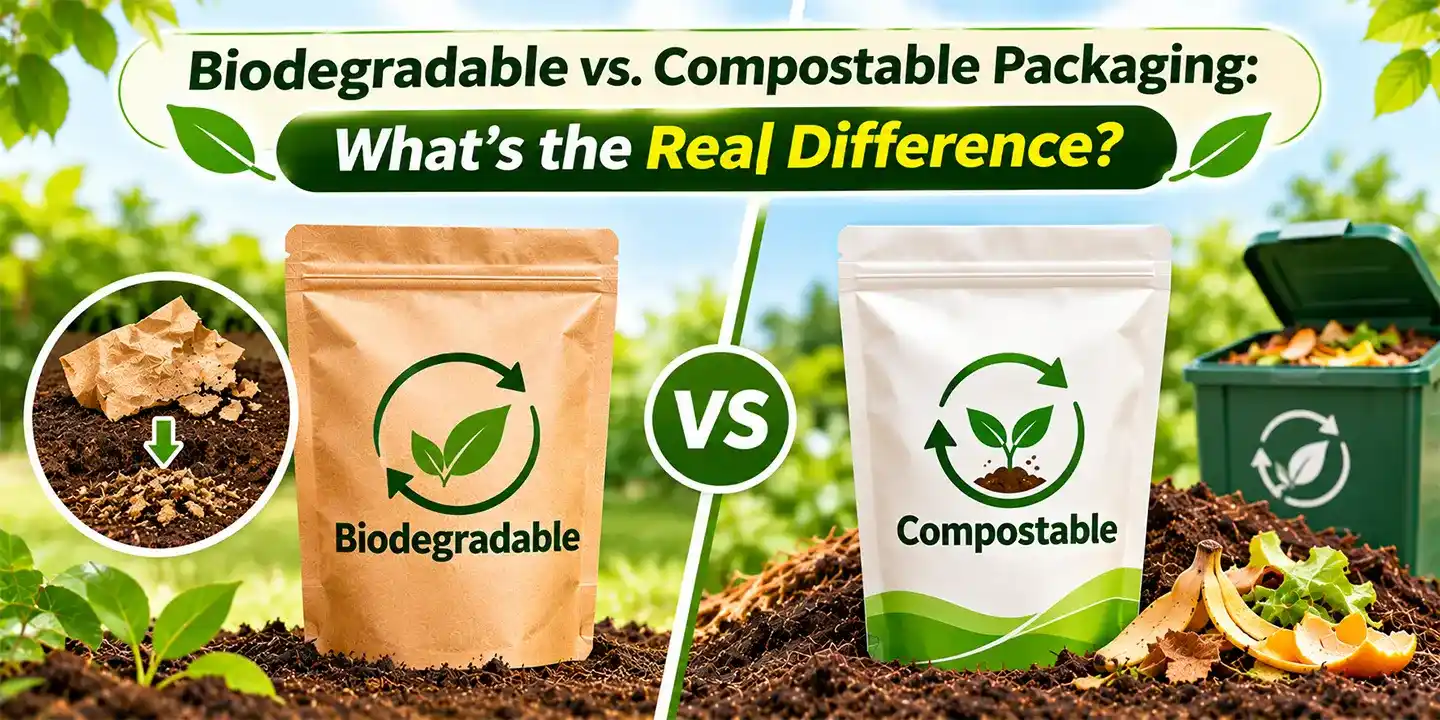
Biodegradable vs. Compostable Packaging: What’s the Real Difference?


Have you noticed how more businesses are switching to sustainable packaging to meet eco conscious customer expectations? From food manufacturers to small business owners, all of them are rethinking their packaging choices. Eco friendly packaging has become an important part of brand positioning. But here is where things get confusing. Terms like biodegradable and compostable are often used interchangeably. Even though they describe different breakdown processes.
So what is the actual difference between the two? Learning biodegradable vs. compostable packaging can help you avoid misleading environmental claims. Let us explore both options and see which one fits your product requirements. Read the article till the end to learn more about it.
What Does "Biodegradable" Actually Mean?
This term refers to materials that can break down naturally through microorganisms such as bacteria and fungi. These organisms consume the material and convert it into simpler substances under suitable conditions. But not every biodegradable material breaks down at the same speed. The process depends on its composition and temperature.
The Hidden Catch of Biodegradables
Here is something to think about: biodegradable does not mean fast-decomposing. Some materials can take many years to break down, especially when they are exposed to unsuitable disposal conditions. Biodegradable materials that are plastic based can also leave behind microplastics or other residues. This is why brands should look beyond marketing claims and check the actual material composition.
What Does "Compostable" Mean?
Compostable packaging takes sustainability a step further. These materials are designed to 100% break down under specific composting conditions and turn into natural elements. These elements include water (H2O), carbon dioxide (CO2), and biomass. Properly certified compostable packaging must meet defined requirements, unlike ordinary biodegradable materials.
One of the most important things is that the materials do not leave any toxic residue behind. You can look for recognized certifications like ASTM D6400 (US) and EN 13432 (Europe) when sourcing compostable packaging for your product. BPI (Biodegradable Products Institute) certification can also be verified to meet applicable compostability standards.
Home Compostable vs. Industrial Compostable
Not all compostable packaging works in the same environment. There are two main types. And the materials used in each can differ. Here are the differences between the two:
Home Compostable
These materials are designed to break down in home composting systems. Common examples include uncoated kraft paper and certain PLA blends. They generally decompose under less controlled conditions. However, suitable moisture and airflow are still necessary.
Industrial Compostable
The materials require controlled composting facilities with specific heat and moisture. Most common examples of the materials include compostable bioplastic films and certified compostable food service bags. These materials need higher temperatures and controlled conditions. This is why they are not necessarily suitable for backyard composting.
One must check the product’s compostability certification and disposal instructions before selecting any of the options. Not every kraft paper bag or cornstarch-based pouch is automatically compostable. Always check the material composition and certification rather than relying on the packaging label alone.
The Core Differences: Biodegradable vs. Compostable
The use of both options is to reduce the environmental impact of packaging. But their performance and disposal requirements are different. Here is a quick tabular comparison:
| Comparison Factor | Biodegradable Packaging | Compostable Packaging |
|---|---|---|
| Breakdown Time | There is no fixed timeframe, and it can take months or years. | The material is designed to break down within 90 - 180 days under specified conditions. |
| Environmental Residue | Some plastic-based materials can leave microplastics behind. | Certified materials do not leave harmful toxic residues under proper composting conditions |
| Required Environment | It depends on the material and surrounding conditions. | It requires suitable composting conditions. This includes moisture, oxygen, and heat. |
| Material Composition | This can include natural and synthetic materials | It must meet defined compostability requirements. |
| Disposal | It depends on its decomposition properties and local waste systems | This requires a suitable home or industrial composting system |
| Certification | Biodegradability claims should be supported by relevant testing. | Compostability is assessed against specific standards and certification requirements. |
Why Sustainable Packaging Matters for Food and Retail Brands
Packaging does more than protect your products. It also communicates what your brand stands for. Customers today pay attention to material choices. This also depends on disposal instructions and the amount of packaging waste associated with it. Below are the advantages food businesses get when switching to sustainable packaging:
It Builds Customer Loyalty
Customers who are environmentally conscious are more likely to appreciate brands that make responsible packaging choices. This helps in gaining more loyal customers for the food business.
Improved Shelf Appeal
The natural looking materials and thoughtful packaging designs can help products stand out. This makes your product attractive in the eyes of customers.
Better Brand Positioning
Sustainable packaging can make your brand more powerful when it is backed by genuine material choices.
It Reduces Packaging Waste
Unnecessary packaging waste can be avoided when practical pouch sizes and suitable materials are chosen.
They Meet Market Expectations
Following the relevant international eco standards can support your brand sustainability goals and packaging requirements.
Eco-Friendly Solutions for Your Brand: Custom Pouches & Mylar Bags
Looking for flexible packaging that combines product protection with thoughtful material choices? LabelPouches offers personalized solutions for different food, retail, and product applications. You can create packaging around your product’s actual requirements. From material selection to printing and closure.
Traditional Mylar bags are not 100% biodegradable. But that does not mean you have to stick with conventional packaging. We offer various alternative materials like PLA and PHA which are plant based bioplastic and are biodegradable. We also offer cellulose-based films and kraft composites that are suitable for items like tea and dry foods.
You can also explore suitable material structures that go with the sustainability goals. We provide various options in terms of styles and shapes. You can also choose the size, such as a 3.5-gram Mylar bag or a small stick pack, according to your preferences. Moreover, you can choose the shape and other attributes as per your product requirements. We offer:
Sustainable Stand up Pouches
Need packaging that looks good on retail shelves and keeps products properly organized? Stand up pouches are a good solution for food, snacks, and other retail products. They have a gusseted bottom that allows the pouch to stand upright without any additional support.
You can personalize these pouches with different dimensions and printing options. We provide suitable eco friendly materials like kraft to make your packaging more sustainable. Material selection should depend on the shelf life requirements of the product and the claims of compostability or recyclability you intend to make.
High Barrier Custom Mylar Bags
What if your product needs protection from oxygen and other contaminants like humidity? This is where custom Mylar bags with an oxygen absorber can make a difference. These bags use multi layer barriers to control the oxygen transmission rate (OTR). They also help in controlling the water vapour transmission rate (WVTR). This helps in maintaining product quality and extending shelf life when the barrier structure is selected correctly.
You can personalize the material and include PCR (Post-Consumer Recycled) layers to reduce your environmental impact. These high-barrier bags are extremely useful for extending the shelf life of packaging coffee and dried foods.
Customized Closures (Zippers & Spouts)
A compostable pouch is only truly eco-friendly if its closure is too. LabelPouches offers certified compostable zippers and spouts to ensure your entire packaging meets zero-waste standards. A good pouch needs a closure that makes everyday use easier. After all, customers may not finish the entire product in one sitting. Different closure options that are offered by LabelPouches are mentioned below:
Press to Close Zippers
It allows customers to open and reseal packaging without additional clips or containers. You get interlocking tracks that can lock again once they have been opened.
Resealable Closures
They help maintain product freshness after opening and reduce unnecessary product waste. This makes the bag airtight and water resistant.
Spouts
Spout pouches have a nozzle that can be added to the opening. They make liquid and semi-liquid products easy to pour and dispense.
Where to Buy Biodegradable and Compostable Packaging?
If you want to get personalized pouches and other packaging options that are according to international eco standards, you should definitely opt for LabelPouches. We offer high quality packaging in materials that have less environmental impact. We also provide multi barier metallized compostable pouches to help improve product protection.
You can personalize each aspect according to your needs. Be it a Mylar bag for food storage or a CBD Mylar bag, you can create any packaging that suits your products and leave minimum carbon footprints. What are you waiting for? Contact us today and request a custom quote now.
Final Thoughts
Choosing between biodegradable and compostable packaging is not just about following a sustainability trend. It is about understanding what happens to your packaging after customers finish using your product. A packaging material may sound eco-friendly, but does it provide enough barrier protection? Can customers dispose of it properly? These are the questions worth asking before making a switch.
At LabelPouches, you can explore different flexible packaging options. Be it for herbs and spices or snacks and CBD products, you can make your packaging choices count. Choose materials carefully and give your customers a packaging experience they can feel good about.